
Receiving an invoice request from Amazon can be one of the most stressful moments for any seller.
For many sellers, the first thought is:
“I already have invoices, so I should be fine.”
Unfortunately, it doesn’t always work that way.
Over the years, I’ve seen many Amazon sellers put their accounts at risk—not because they lacked invoices, but because the documents they submitted did not actually meet Amazon’s requirements.
And in many cases, submitting the wrong documents too quickly made the situation even worse.
If Amazon has requested invoices for authenticity verification, here is the most important thing to understand:
Having invoices is not enough. The way you present and validate them matters just as much.
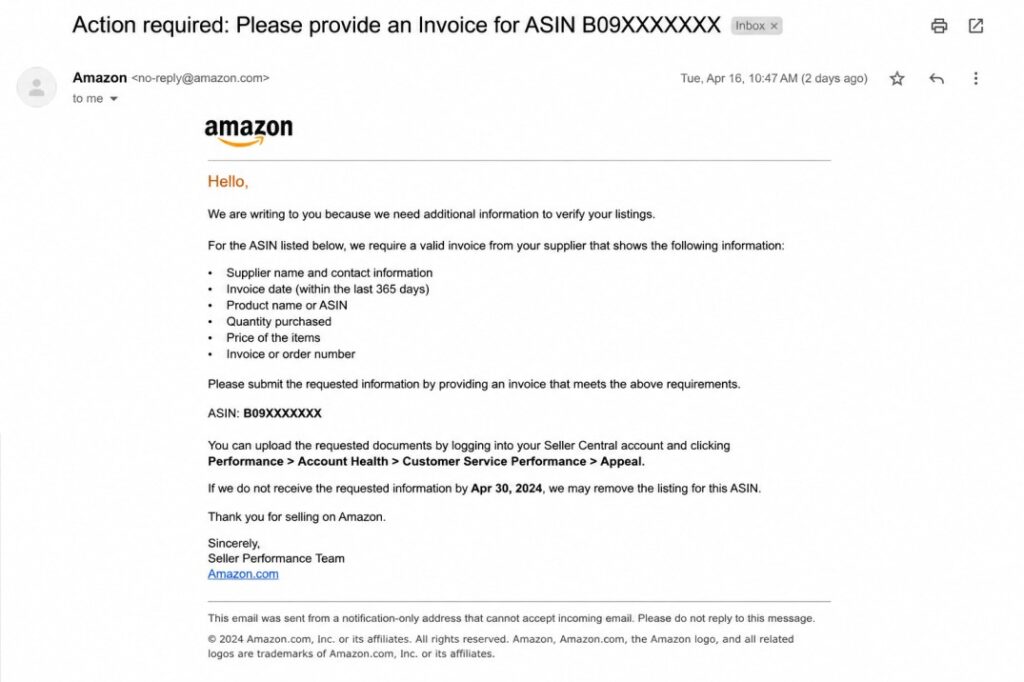
Why Does Amazon Ask for Authenticity Invoices?
Amazon is highly focused on protecting customers from counterfeit or unauthorized products.
When Amazon suspects a product may not be authentic, they may request documentation to verify your supply chain.
This usually happens due to:
- Customer complaints about authenticity
- Intellectual property complaints from brands
- Unusual selling patterns
- Sudden spikes in sales
- High-risk product categories
In these cases, Amazon may ask for:
- Supplier invoices
- Purchase orders
- Authorization letters
- Supply chain documentation
The goal is simple:
Amazon wants proof that your products come from a legitimate source.
The Most Common Invoice Mistakes Amazon Sellers Make
Here are the biggest problems I repeatedly see when sellers respond to invoice requests.
1. Incomplete Invoices
This is one of the most common reasons invoices get rejected.
Many sellers submit invoices missing critical information such as:
- Supplier name
- Supplier address
- Supplier phone number
- Purchase date
- Product details
- Quantity purchased
Amazon needs enough information to verify the supplier and the products.
If important fields are missing, the invoice may be considered invalid.
Before submitting, ask yourself:
Can Amazon clearly verify who sold me this inventory?
If the answer is unclear, that’s a red flag.
2. Non-Verifiable Suppliers
Even if your invoice looks professional, Amazon may still investigate the supplier.
This is where many sellers get surprised.
Amazon may search for:
- Business registration
- Official website
- Contact details
- Online presence
- Proof of legitimate operations
If your supplier has no website, no digital footprint, or inconsistent business information, Amazon may question the entire supply chain.
This creates a trust problem.
Remember:
Amazon doesn’t just verify documents.
They often verify the business behind the documents.
3. Retail Receipts Instead of Wholesale Invoices
This mistake happens constantly.
Many sellers submit receipts from retailers such as:
- Walmart
- Costco
- Target
- Best Buy
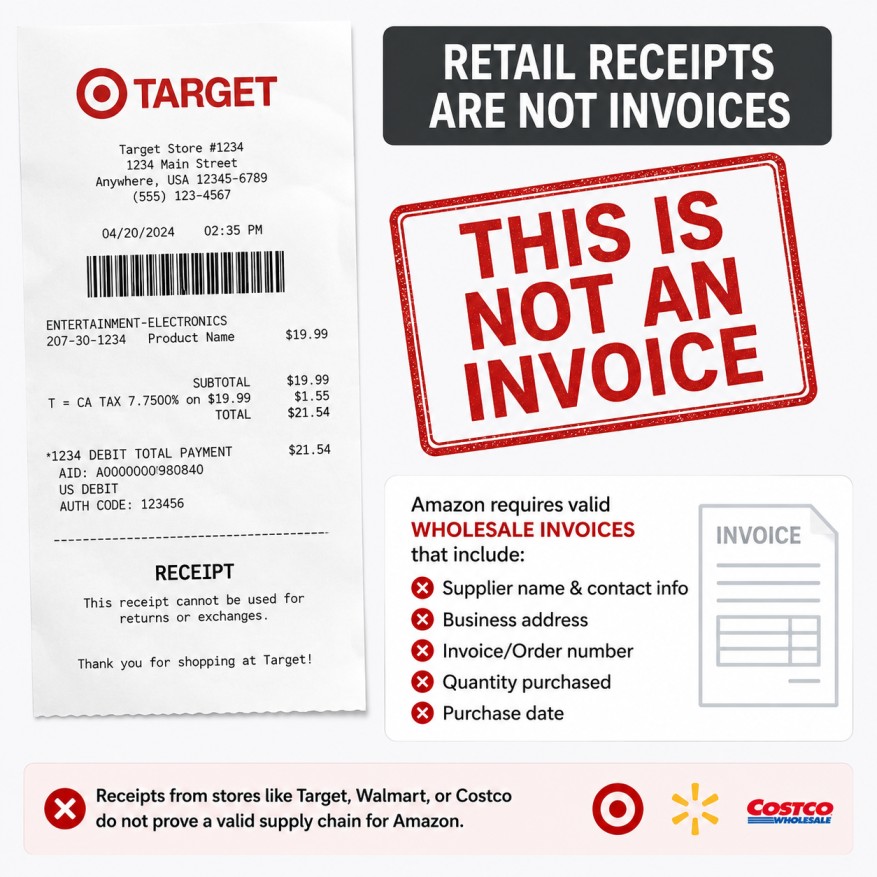
The problem?
Retail receipts usually do not prove a valid wholesale supply chain.
In many categories, Amazon expects documentation showing inventory acquired from:
- Manufacturers
- Authorized distributors
- Wholesale suppliers
A retail receipt only shows that you bought a product as a consumer.
That often isn’t enough.
This is especially risky when dealing with branded products.
4. Invoice Quantities Don’t Match Inventory
This is another major issue.
Example:
Your invoices show purchases of 20 units, but your Amazon account sold 200 units.
That discrepancy raises immediate concerns.
Amazon may ask:
- Where did the additional inventory come from?
- Can the seller prove the source of all units sold?
If quantities don’t align, Amazon may suspect:
- Unauthorized sourcing
- Counterfeit inventory
- Incomplete documentation
Always ensure your documentation supports your sales volume.
The Real Problem: Sellers Rush Their Response
Here’s what often happens.
A seller receives the dreaded Amazon notification.
Panic sets in.
They think:
“I need to respond ASAP so I can recover my account.”
Speed matters—but panic is dangerous.
Submitting poor documentation can:
- Trigger additional reviews
- Delay reinstatement
- Strengthen Amazon’s concerns
- Lead to listing removal or account suspension
Sometimes the biggest mistake isn’t the original issue.
It’s the rushed response.
How to Respond Strategically to Amazon Invoice Requests
If Amazon requests invoices, follow a structured process.
Step 1: Review Amazon’s Request Carefully
Read every detail.
Check:
- ASIN involved
- Date range requested
- Document requirements
- Specific compliance concerns
Step 2: Audit Your Documents
Verify that your invoices are:
✔ Complete
✔ Clear
✔ Legitimate
✔ Consistent with sales volume
Step 3: Validate Your Supplier
Ask:
- Can Amazon verify this supplier?
- Is their business real and traceable?
Step 4: Submit Professionally
Organize documents clearly.
Avoid:
- blurry scans
- cropped pages
- edited documents
- unnecessary explanations
Clarity matters.
Final Thoughts
The biggest misconception sellers have is this:
“If I have invoices, I’m safe.”
That is not always true.
In many cases, the issue is not the absence of invoices.
The issue is that the evidence was incomplete, inconsistent, or poorly presented.
When Amazon asks for authenticity documents, every detail matters.
Act quickly—but act strategically.
Because sometimes, the difference between reinstatement and suspension comes down to how well your documentation tells the story of your supply chain.
Need Help Reviewing Your Amazon Invoices?
If Amazon requested invoices and you’re unsure whether your documents meet Amazon’s standards, getting a professional review before submitting can help you avoid costly mistakes.
A strategic response today can protect your listings—and your business.
Click on the button below to contact me for FREE if you need guidance about an amazon request: