
Receiving an Amazon account suspension can be one of the most stressful situations for any seller. When your account is deactivated, every day without selling means lost revenue, delayed orders, and uncertainty about your business.
Unfortunately, many sellers make the mistake of rushing to submit a Plan of Action (POA) without fully understanding what Amazon expects. In many cases, the appeal is rejected—not because the account cannot be reinstated, but because the Plan of Action fails to address Amazon’s concerns.

If you’re preparing an appeal, avoiding the following five mistakes can significantly improve your chances of success.
1. Blaming Amazon Instead of Taking Responsibility
One of the biggest mistakes sellers make is trying to convince Amazon that the suspension was unfair.
Statements such as:
- “Amazon made a mistake.”
- “The customer was lying.”
- “Your system incorrectly suspended my account.”
rarely help your case.
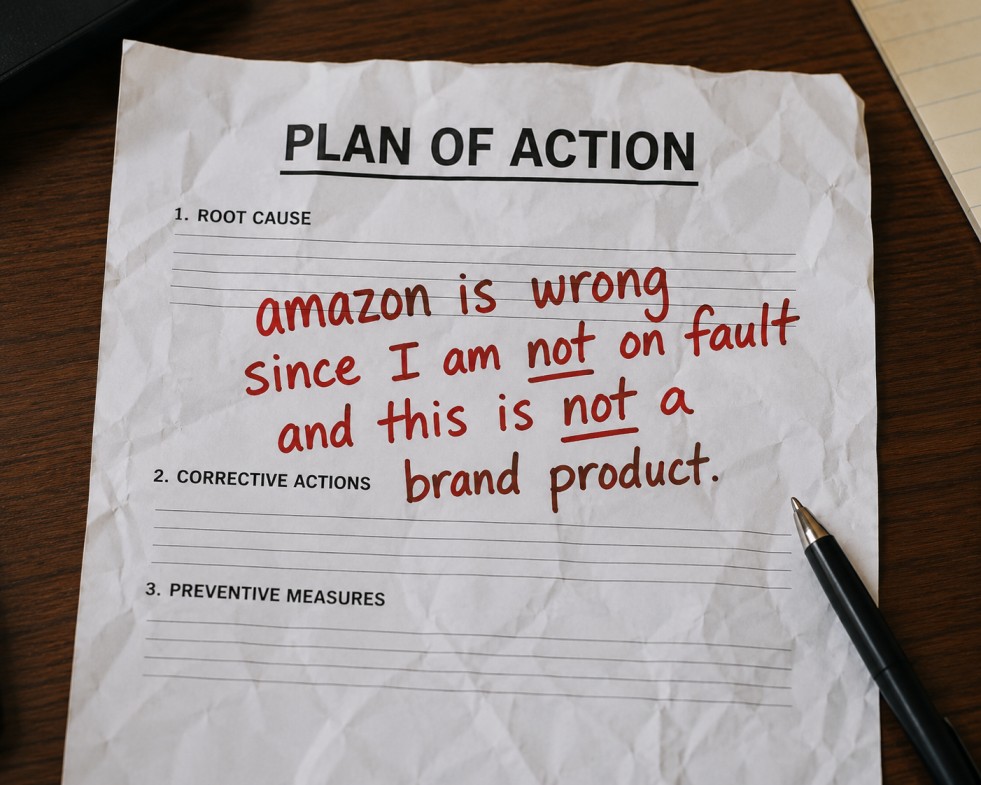
Amazon’s investigators are not looking for arguments. They want to know that you understand why the issue occurred and what you have done to prevent it from happening again.
Even if you believe the suspension was triggered by a misunderstanding, your Plan of Action should remain professional, objective, and focused on solutions rather than blame.
2. Failing to Identify the Root Cause
A successful appeal starts with identifying the real reason behind the suspension.
Many sellers simply write:
“I violated Amazon’s policy.”
This is not a root cause.
Instead, explain exactly what caused the problem.
For example:
- An employee uploaded inaccurate product information.
- Inventory was sourced from a supplier that could not provide acceptable invoices.
- Quality inspections were not performed before shipping.
- Customer complaints were not properly analyzed.
Amazon wants to see that you understand why the issue happened—not just what happened.
Without a clear root cause, the rest of the appeal loses credibility.
3. Promising Improvements Without Evidence
Many appeals include vague statements like:
- “We will improve our processes.”
- “We will be more careful.”
- “This will never happen again.”
These promises carry very little weight.
Instead, describe the specific actions you have already implemented.
Examples include:
- Verified all suppliers before placing new orders.
- Implemented a documented quality inspection process.
- Removed inventory that could not be verified.
- Retrained employees on Amazon policies.
- Updated internal Standard Operating Procedures (SOPs).
Whenever possible, support these actions with documentation.
Evidence is far more persuasive than promises.
4. Writing an Appeal That Is Too Long
Many sellers believe that a longer appeal demonstrates greater effort.
In reality, lengthy appeals often make it harder for Amazon investigators to identify the important information.
A strong Plan of Action should be concise and organized into three clear sections:
Root Cause
Explain why the issue occurred. Try to explain it in a clear and detailed way, avoiding being too general and writing just one line.
Corrective Actions
Describe the steps you took to resolve the existing problem.
Preventive Measures
Explain the long-term changes that will prevent the issue from happening again.
Avoid unnecessary history, emotional explanations, or unrelated business information.
The easier your appeal is to review, the better.
5. Copying Templates from the Internet
There are thousands of free Amazon appeal templates online.
While they may look convincing, they rarely address the specific circumstances of your suspension.

Amazon reviewers read thousands of appeals every year and can quickly recognize generic templates.
A copied Plan of Action often:
- Fails to address the actual policy violation.
- Includes irrelevant corrective actions.
- Lacks supporting documentation.
- Appears generic and untrustworthy.
Every suspension is different.
Your appeal should be written specifically for your account, your products, and the exact reason Amazon suspended your selling privileges.
What Makes a Strong Plan of Action?
Although every case is unique, successful appeals generally include:
- A clear and honest root cause.
- Specific corrective actions already completed.
- Long-term preventive measures.
- Supporting documentation whenever possible.
- Professional, concise language.
- A logical structure that is easy to follow.
Remember, Amazon wants confidence that the same problem will not happen again.
Your appeal should demonstrate that confidence.
Conclusión
A rejected Plan of Action does not always mean your account cannot be reinstated.
More often, it means Amazon was not convinced that the underlying issue had been fully identified and resolved.
Before submitting your next appeal, ask yourself:
- Have I clearly identified the root cause?
- Have I provided evidence of the corrective actions?
- Is my appeal concise and easy to understand?
- Does it explain how I will prevent this issue in the future?
- Is every section specific to my suspension?
Taking the time to answer these questions can significantly improve your chances of a successful reinstatement.
If you’re facing an Amazon account suspension, remember that a well-prepared Plan of Action is not about writing more—it is about demonstrating that you understand the problem and have implemented meaningful solutions to prevent it from happening again.
If you want someone to check your case and prepare a good plan of action as soon as possible to avoid losing more money, contact me by clicking on the button below: